Basic English Usage
Articles
Introduction
The importance of articles
Some people don't have articles in their native language, so when they write English they omit articles because it feels natural to do so. Other people feel it is better to make the mistake of omitting an article than it is to make the mistake of using the wrong article. So it is natural that the typical default behavior is, "when in doubt, leave it out." But you will not do that. You will try to use articles correctly. You will commit to learning, over time, all the unique (and odd) ways that articles are used in English.
A Question: How will people fluent in English react if I omit articles that I am not sure about?
An Answer: It varies, but in general, here is how they can react to your writing when it has errors in the use of articles.
articles omitted:
"Meeting yesterday was helpful. You asked me to send email to describe what we offer. Brief description is provided below. Easy way to learn more is to read products page on our website."
People fluent in English may think, this person
- is probably smart, but not thoughtful
- does not care about being clear
- might not want to work with me
articles used incorrectly:
"A meeting yesterday was helpful. You asked me to send the email to describe what we offer. The brief description is provided below. A easy way to learn more is to read a products page on our website."
People fluent in English may think, this person
- is smart, though not perfect
- is trying to be clear
- probably wants to work with me
articles used correctly:
"The meeting yesterday was helpful. You asked me to send an email to describe what we offer. A brief description is provided below. An easy way to learn more is to read the products page on our website."
People fluent in English are likely to think, this person
- is smart
- is clear
- enjoys working with me
- could be fluent in English
A versus An
A Question: When should I use a, and when should I use an?
An Answer (in the form of a question): Can I sing the beginning of the next word?
If you can sing the first sound of the next word, use an in front of that word.
a payment → first sound : p
an easy payment → "ee" ♫
a late payment → l
a one-time payment → w
an honest payment → "ah" ♫
a useful payment → y
an uber payment → "ue" ♫
One way to remember this custom is to pretend you are an opera singer, warming up:
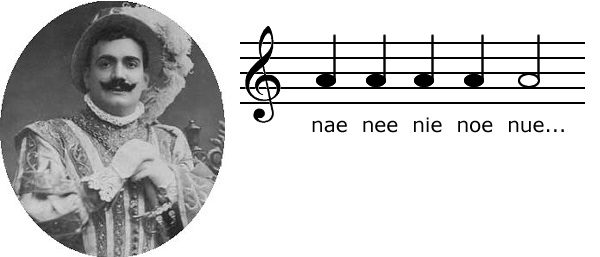
Try the Exercises. Don't worry about guessing and getting things wrong. That's the purpose of this course. With every "Oh, yeah, that's the proper way to do it!" realization, you will steadily improve your writing in the workplace.
Lesson: Introduction
Module: Articles
Course: Basic English Usage